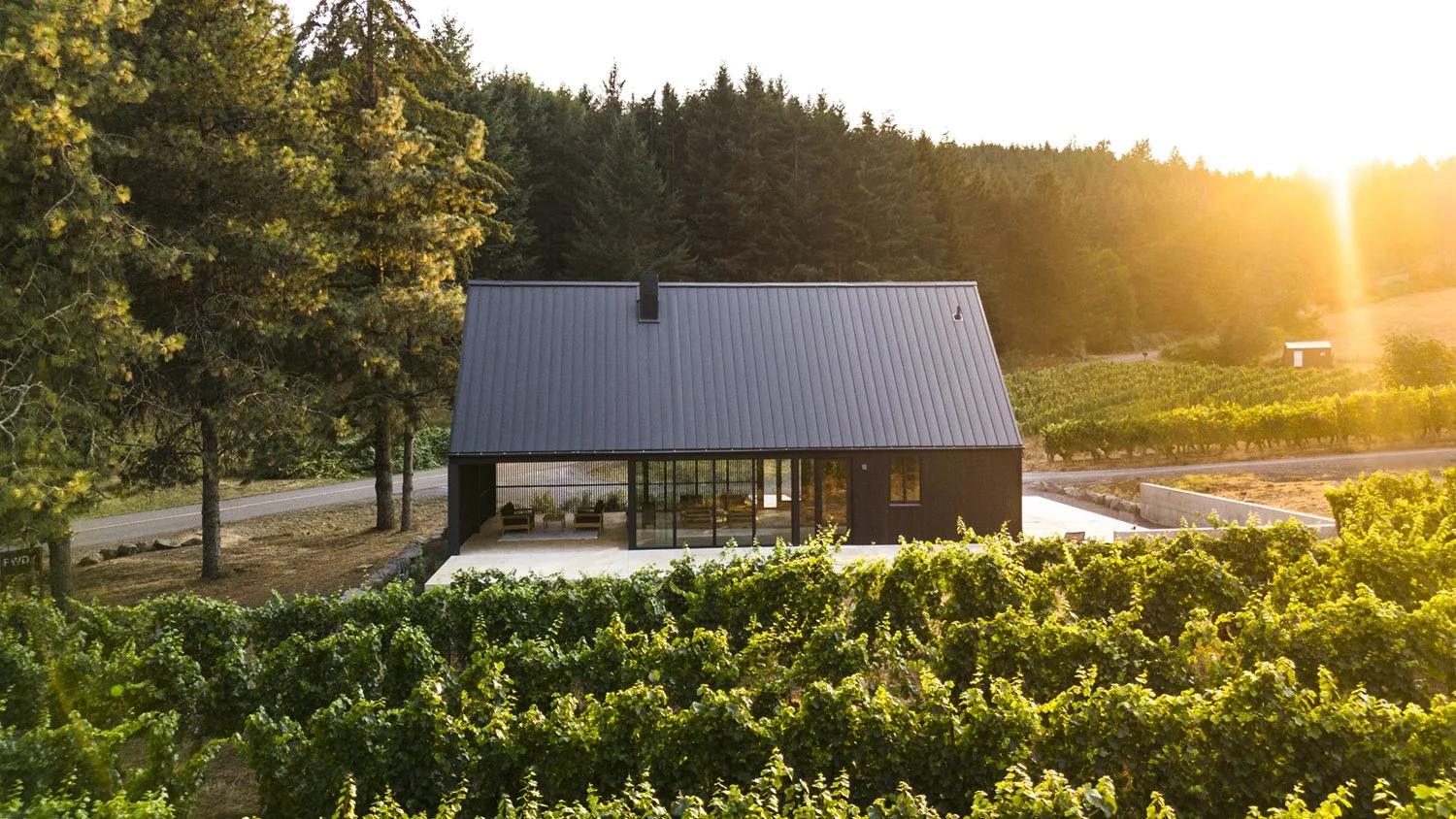
ABOUT THE WOODSHED VINEYARD
The history of the 48-year-old Woodshed Vineyard is intertwined with many of the key figures that helped establish Willamette Valley winegrowing and winemaking.
Our Pinot Noir vineyard was first planted in 1978 by Jim McDaniel in the Dundee Hills, with design guidance by David Lett and vines sourced from Dick Erath. The vineyard was sold to Mike and Robin Murto in 1991 and re-named Murto Vineyard. The Murtos expanded the vineyard and cared for the vines for over 25 years, supplying leading wineries such as Winderlea, White Rose Estate, Ayoub, and Belle Pente with fruit that became single-vineyard Murto releases.
These releases developed a devoted following over time, and attracted the attention of Anthony and Lindsay Van Nice. In 2018, the vineyard site was acquired by the Van Nice family, who founded Woodshed Wine Company on the 26-acre property. Today, our plantings include 7.6 acres of old vine Pinot Noir (mostly own-rooted Pommard) and 3 acres of 1992 Pinot Noir (own-rooted Pommard interplanted with Wädenswil). We dry farm the vineyard, with half of the fruit destined for our wine program and the rest under contract to Antica Terra. In 2025, our vineyard was certified LIVE Sustainable.
For those curious about the five decades of stories behind our vineyard, read on…
“Tom Gunnas was a loan officer at the First National Bank in McMinnville… he called me on the telephone and he said, ‘I've got some crazy guy here that wants to make wine in Oregon… Let's get together for lunch at the Blue Moon Tavern in McMinnville and listen to what [David] Lett has to say. So we did that. We had a good time.” —Jim McDaniel
Jim heard the knock on his granary door in McMinnville, not realizing it would change the direction of his life forever.
The person at his door was no other than David Lett, who Jim had previously entertained at the Blue Moon. David had shared his theories about how Oregon’s Willamette Valley was perfectly suited for growing Pinot Noir and making world-class wine, and Jim was intrigued.
The year was 1969, and David was looking for a spot to make wine. The story goes that Jim chose to rent him the space in his granary for almost nothing, and Jim would help with the winemaking for The Eyrie’s first vintage.
This wasn’t Jim’s first encounter with wine. In the 1950s, Jim went to college at University of Oregon for Far Eastern Studies, and ended up moving to Yamhill to help run a family business called McDaniel Grain and Feed Mills. But in his free time, he loved to travel through California and explore the wines being produced across the state.
After his experience making wine with David, Jim decided to move on from his family business and strike out on his own as a winegrower and winemaker with his wife Donna Jean and children. Between 1971 to 1973, the McDaniels purchased and cleared three tracts of land in the Red Hills of Dundee, and the family began the process of establishing them as vineyards.
On the largest 15-acre site, they built a Japanese inspired home next to 7 acres of grape plantings. The second parcel they acquired from the Maresh family, and planted Pinot Noir, Pinot Gris, Riesling, and Chardonnay grapes. The McDaniels would go on to sell this property in 1976, when he realized that farming three sites was too much to handle.
The third parcel of land forms the core of the Woodshed Vineyard, and of the three sites, is the only one that still has all of its original own-rooted Pinot Noir plantings—almost exclusively own-rooted Pommard.
Jim would become a mentor and collaborator with other winegrowers and winemakers in the region, working with Dick Erath, Ken Wright, David Lett, Charles Coury, Myron Redford, Rollin Soles, and the Ponzi family. He also sold fruit to many of these big names. Jim was affectionately known as the “renaissance man” due to his pursuit of many passions including Japanese gardening with his wife, piano playing, winemaking, and his stewardship of his community. He was integral in the collaborative ethos of lending a press or a hand.
In the mid-eighties, the McDaniels family grew tired of farming and sold off their largest vineyard property to Dr. Don Olson, who renamed the site to Torii Mor Vineyard. After retiring from winegrowing, he maintained and created a showpiece garden for Argyle for 19 years and served as a wine educator at Rex Hill.
Chapter 1: Pinot Noir Winegrowing with Jim McDaniel (1978–1991)
Chapter 2: Robin & Mike Murto Expand the Vineyard (1992–2018)
“We certainly did not move out here with the intention of starting a vineyard.” —Robin Murto
Robin and Mike Murto moved to the Dundee Hills in 1991, purchasing six acres of land next door to the McDaniel vineyard property. They had day jobs in technology and manufacturing, and no intention of growing grapes—but the land was in farm deferral. “We either had to continue its agricultural use or pay five years of back taxes. After looking out our window and seeing Erath Vineyards, we thought a vineyard would be the logical choice.”
In 1992 they purchased Pinot Noir plantings directly from Dick Erath, mostly Pommard with a smattering of Wädenswil. According to their hand-written vineyard log, they planted 700 vines between March 15 and April 26, 1992. Later that year the original 20-acre parcel planted by Jim McDaniel went on the market, and they chose to acquire it.
Farming would become Robin and Mike’s “5 to 9” job on evenings and weekends, and the first years of winegrowing weren’t without their growing pains. The Murtos read books and sought out advice from other local winegrowers, with Jim Maresh and Dick Erath signing on as mentors. They each had their own tractor, and split up the farming tasks such as cutting canes, spraying sulfur, and pruning.
From the start, wines made from Murto vineyard fruit received national praise and standout 90+ scores in leading industry publications. For example, the New York Times described a Murto Vineyard Pinot from the 1998 vintage “as thickly textured as any California Pinot… ripe and satisfying”. Wineries with long-term contracts and top-rated wines from the Murto Vineyard during these two decades included:
Belle Pente: Brian O’Donnell as winemaker (1996–2019)
Winderlea: Bill Sweat, Donna Morris, and Robert Brittan as winemakers (2005–2019)
White Rose Estate: Jesus Guillen as winemaker (2014–2017)
Other wineries with standout vintages designated as Murto Vineyard Pinot Noir include Ayoub, Granville, and Raptor Ridge.
In an interview with the Newberg Graphic, the Murtos reflected on their first two decades owning the vineyard, saying they never “worked so hard, met so many nice people, or enjoyed such great wines as we have while owning this vineyard. When we set down this path in 1991, we had no idea where it would take us. But, in hindsight, it’s been a great journey and one we’re both happy to have taken.”
Chapter 3: The Van Nice Family Establish Woodshed (2018–Present)
“Owning the Woodshed Vineyard is a lifelong dream that came true.” —Anthony Van Nice
When Robin and Mike Murto decided to sell the vineyard and their home on the property, Anthony Van Nice was first to the table with a bold proposal: continuing the 40+ year legacy of their historic vineyard and establishing a small family winery on the property itself.
Anthony first became aware of the vineyard when he was in his twenties and starting his career in the Oregon wine community. Before he was even of drinking age, he was working as a cellar hand for the first vintage at Archery Summit. Driving down Worden Hill Road, he imagined that someday he might own an old-vine vineyard like Murto in the Dundee Hills.
After completing his bachelor’s degree at Lewis and Clark College, he interned in world-renowned regions such as Burgundy, Napa Valley, Hunter Valley (Australia), and Central Otago (New Zealand), before returning to the Willamette Valley. As he mastered winegrowing and winemaking, he became curious about winery operations. This led him to take on the role of first hire and general manager at The Four Graces, which he would grow from its inception until its sale to Foley. From there, he would serve as president of Solena Estates and establish his own successful private label winemaking business.
Across his 31 year career, Anthony’s wines have earned hundreds of 90+ point scores from top industry publications, including Wine Spectator, Wine Advocate, Wine Enthusiast, and James Suckling, solidifying his reputation in the region. But the Murto Vineyard stood out to Anthony as something singular and special, a ‘grand cru’ site in the Dundee Hills. He personally wanted to craft the highest quality wines possible from the vineyard’s old-vine fruit.
Anthony and Lindsay Van Nice took ownership of the Murto Vineyard in July 2018 and renamed it Woodshed Vineyard. Today, Woodshed Wine Company produces an average of about 700 cases of wine per year, which includes our Estate Pinot Noir (1992 plantings) and Old Vine Pinot Noir (1978 plantings). We also partner with our neighbor Eugenia Keegan, owner and winegrower of Thirsty Boots Vineyard, to produce wines from 2018 plantings of Chardonnay and Pinot Noir farmed to a certified organic standard. In 2025, Woodshed Vineyard was certified LIVE Sustainable.
Woodshed’s wines are only available for sale directly from our tasting room and by joining our allocation list. Visit our tasting room in the Dundee Hills and experience Woodshed for yourself—we’d love to host you and share an important part of Oregon’s wine history.